Federal Aid Could Starve Off Transit Cuts
The majority of service cuts approved by the MTA to deal with a huge budget deficit are looming. While some cuts such as those on the LIRR have already gone into effect, legislation unveiled yesterday in Washington D.C. could help starve off cuts. Let us first take a look at the report from Washington D.C. Streetsblog Reporter Elana Schor:
Transit agencies forced to raise fares or cut service to close budget gaps would be eligible for $2 billion in emergency operating funds under legislation unveiled today by Senate Banking Committee Chairman Chris Dodd (D-CT) and seven other Democratic senators, including two members of the party’s leadership.
harry_reid_christopher_dodd_max_baucus_charles_schumer_richard_durbin_2009_8_4_16_40_23.jpgSens. Chris Dodd (D-CT), left, Charles Schumer (D-NY), right, and Dick Durbin (D-IL), second from right, with Majority Leader Harry Reid (D-NV). (Photo: AP)
The transit operating bill would authorize $2 billion in federal grants aimed at helping local transit agencies reverse already-imposed service cuts, fare increases, or worker layoffs — provided that those changes were forced by a shortfall in state or local transport budgets that took effect after January 1, 2009. Any agency planning future service cuts or fare hikes could use their grant money to stave off those moves until September 2011.
Click here for the complete report.
Now let us take a look at a press release about the legislation from New York Senator Sen. Charles Schumer’s office:
United States Senators Charles E. Schumer and Kirsten E. Gillibrand introduced today an emergency transit bill that would restore major reductions in public transit services and stave off future fare hikes imposed on commuters throughout the New York City subway system, Long Island Railroad, and Metro North Railroad. Under existing transit formulas, the NYC-NJ-CT urbanized area would be in line to receive roughly $345 million.
“Mass transit is the very lifeblood of the New York and our ability to rebuild the economy and get people back to work is linked to a fully funded and affordable system,” said Schumer. “In a time of crisis, when funding for mass transit has collapsed and caused severe service cuts, layoffs and looming fare hikes, it is essential that we take strong action to ensure the middle class can afford to use public transit. ”
“Commuters in New York are outraged by the fare hikes and service cuts that are being considered right now,” said Senator Gillibrand. “This emergency funding is badly needed to maintain strong and affordable transit systems that get workers to work, students to school, and keep our economy moving.”
MTA service cuts have begun to be phased in over the last several weeks and additional cuts are expected to continue into June. Last week, the Long Island Railroad eliminated service to its Belmont Station and reduced the number of trains that arrive on the eight trains on the Babylon, Long Beach, Port Jefferson, and Port Washington branches. Budget woes will force the elimination of the M Train and dozens of service cuts and bus line eliminations throughout the five boroughs. The MTA is currently facing a deficit of $400 million. State funding for the mass transit system was reduced in 2010 by $143 million.
The Public Transportation Preservation Act would provide $2 billion in emergency assistance for operating expenses necessary to restore a major reduction in public transportation service and to hold off future fare increases due to decreased state or local funding that occurred on or after January 1, 2009. Funding would be distributed through existing formulas. It is expected that the NYC-NJ-CT urbanized area would receive $345.25 million. The Act will help transit agencies avoid or minimize future service reduction and fare increases that are being contemplated through the end of FY 2011.
New Jersey State Senator Frank Lautenberg’s office issued their own press release to highlight the $125M New Jersey Transit would receive if this legislation becomes law:
Today U.S. Sens. Frank Lautenberg (D-NJ) and Robert Menendez (D-NJ) joined Senate Banking, Housing, and Urban Affairs Committee Chairman Chris Dodd (D-CT) to introduce a bill that would authorize emergency funding for transit agencies to help reverse fare increases and service cuts.
“This measure would provide critical relief to New Jersey’s commuters and transit riders across the country when they need it most. Investing in transit will help stem fare hikes and improve service so that working class families can get to work on time and without breaking the bank,” Lautenberg, a member of the Senate Commerce, Science and Transportation Committee said.
“Cutbacks at NJ Transit has made transit service for New Jerseyans more expensive and less accessible. This is a moment in which we should be investing in our public transportation, not undermining it. Emphasizing mass transit helps rebuild our economy through lower commuting costs, new jobs and cleaner air.” Senator Menendez, who is chairman of the Banking, Housing and Urban Affairs Subcommittee with jurisdiction over mass transit said.
“While families continue to struggle to make ends meet the last thing we should do is make it harder and more expensive for people to get to work. This bill will prevent disruptive service cuts and help put money back in the pockets of families when they need it most,” Chairman Dodd said.
State and local governments have been hit hard by the downturn in the economy and public transportation systems nationwide are experiencing major budget cuts as a result. The American Public Transportation Association reports that since January 1, 2009, 84 percent of public transit systems have either raised fares, cut service or are considering those options.
This bill will authorize $2 billion for transit agencies nationwide to help close funding gaps in operating costs. Transit agencies would be able to use these funds to reduce fare increases and restore services that were cut after January 2009 or to prevent future service cuts or fare increases through September 2011. Agencies that have not increased rates or cut services and do not plan to do so may use the funds for infrastructure improvements. NJ Transit would receive an estimated $125 million under this bill.
The legislation is also cosponsored by Senators Dick Durbin (D-IL), Charles Schumer (D-NY), Sherrod Brown (D-OH), Jack Reed (D-RI), and Kirsten Gillibrand (D-NY).
At first glance this seems like great news as it could starve off cuts approved by the MTA not too long ago. However in reality, is this piece of legislation as good as it might seem? My answer is no, let me explain.
I am not a fan of only focusing on the present when the future is equally as important. Another way of looking at it is, I do not believe in band-aid or patchwork fixes to long term problems or wounds. While disaster is avoided in the short term, what about the future? By looking at this potential funding as a success, it should really be looked at as a glaring example of what is wrong & what needs to be fixed.
The MTA & transit agencies around the country need to have adequate funding coming from their city & state governments. They can’t count on the federal government to rescue them every time a financial crisis is set to cripple them. The last thing we need is the federal government taking the much deserved unflattering spotlight away from our city & state officials who continue to financially screw the MTA & its riders.
xoxo Transit Blogger
You might enjoy reading these related entries:- Federal Government Is Getting Serious On Mass Transit Financing
- Local Politicians Hold Press Conference Before Fare Hike Hearing
- $210 Million Grant Approved For LIRR East Side Access Project
- MTA Financial Contingency Plan Could Turn Hypothetical Service Cuts Into Reality
- Bill S3772-A Stalls In The State Assembly
Riders Tripping On New Low Floor Buses
For those who have rode MTA NYC Transit buses over the years, dealing with those steps has proven to be a challenge at one point or another. However the agency has been investing in new low floor buses which have a flat entrance with no steps. One would think that such a bus would prove easier for those who tripped on the older bus stairs.
However that has not been the case according to a brief report in yesterday’s New York Post by Tom Namako & Perry Chiaramonte:
You’d expect this from tourists.
But even the most veteran city bus riders can’t seem to manage the MTA’s new, low-floor buses — tripping over anticipated but nonexistent steps in and out of the vehicle — and their mistakes have brought on a sudden spike in straphanger injuries.
About 7.5 percent more riders — about 75 in all — were injured on low-floor buses from January 2009 to January 2010, as compared with the year before, transit officials said.
Riders are tripping when boarding and stepping off the new coaches.
There are handrails for boarders to grab onto, but the unsteady riders aren’t using them, said Joseph Smith, the MTA’s bus chief.
MTA board member Mark Page noted at a committee meeting yesterday, “You see steps in front of you, and you pay attention. You don’t see steps in front of you, and you launch yourself to the pavement.”The accident spike happened as the MTA introduced 861 new, low-floor buses into the system last year, officials said. The number of injuries has already leveled out from January to the present.
I found the brief report interesting as I immediately wondered if the mental psyche was the cause of these minor accidents. I think the rider’s mind has been so trained to board buses with steps, that they do not know how to react to something that is not really there. Hopefully they will make the adjustment as no one wants to see people get injured or even worse, sue the MTA for illegitimate reasons.
xoxo Transit Blogger
You might enjoy reading these related entries:- MTA To Purchase 120 New Buses
- Car Crashes Into Bus Shelter
- Metro-North Retaliates Against Injured Workers
- MTA Worker Injured In Work Train Accident
- MTA to Announce Major Text Messaging & Email Alert Initiative
LIRR/NJT Team Up For 1 Ticket Concert Access
Summer is only a few short weeks away & you know what that means, prime concert season. As always, the Meadowlands will be the host to many shows. Yesterday afternoon, the MTA Long Island Rail Road (LIRR) announced it was teaming with New Jersey Transit (NJT) to provide 1 railroad ticket access to get to these shows. Here are the complete details:
MTA Long Island Rail Road announces a new round-trip joint (LIRR/NJT) ticket that will have its customers rocking on the rails. LIRR customers traveling to the upcoming Bon Jovi, Eagles, and Hot 97 Concerts at the Meadowlands can bypass the NJ Transit ticket line at Penn Station and buy their tickets at their home stations. The single-purchase, round-trip ticket is good for travel on the LIRR and New Jersey Transit (NJT) on concert days for the standard LIRR fare plus $10.50 for the NJT portion of travel.
Forget about traffic, bridge and tunnel tolls and parking. New Jersey Transit’s new rail line to the Meadowlands delivers concert fans to a new station at the doorstep of the stadium. Simply take a regular scheduled LIRR train to Penn Station and hop aboard a NJT train to Secaucus Junction Station. From there, NJT’s new Meadowlands shuttle train will bring fans directly to Meadowlands Station and the concert. In all, it’s about a 20-minute trip from Penn Station.
Meadowlands Concert Dates:
5/26/10 – Bon Jovi – 7:00 PM
5/27/10 – Bon Jovi – 7:00 PM
5/29/10 – Bon Jovi – 7:00 PM
6/6/10 – Hot 97 Concert – 7:00 PM
6/10/10 – Eagles – 4:30 PM
7/9/10 – Bon Jovi – 7:00 PM
—-
Buying “Train to the Concert” tickets:
From any Long Island Rail Road station to the Meadowlands Sports Complex, tickets can be purchased in the following ways:
At Ticket Office or Ticket Machine:
Purchase a round-trip joint ticket to the “Meadowlands” Station for off-peak travel. The price is the standard LIRR fare plus $10.50 for round-trip NJT portion of travel. NJT one-way fare is $5.25. Since NJT does not sell the joint ticket, LIRR customers are advised to purchase the special round-trip ticket prior to boarding their LIRR train.
LIRR monthly ticket holders simply need to purchase an NJT ticket to Meadowlands at Penn Station at the NJT ticket windows or ticket machines before boarding.
Travel Info:
• Remember, the LIRR and New Jersey Transit are not direct connections, so time your trip accordingly.
• After the concert, shuttle trains will run up to two hours as needed back to Secaucus Junction.
• The Meadowlands Stadium does not allow coolers or any oversized containers on their property.
• The Train to the Concert tickets are NOT VALID for any other Meadowlands event or travel.
• Please remember to take your tickets with you when changing trains.
xoxo Transit Blogger
You might enjoy reading these related entries:- LIRR To Run Belmont Special
- MTA Extends LIRR Atlantic Ticket Program
- New LIRR Fares Take Effect Dec 30th
- LIRR To Streamline Ticket Procedures
- LIRR Special Ticket Package For NY Auto Show
Extra LIRR Trains To Start Memorial Day
Time to catch up on some blogging by starting with a press release the MTA Long Island Rail Road sent me on Monday. The press release was to announce that as usual, they will be running extra trains at the start of the Memorial Day holiday weekend. Here are the complete details:
The MTA Long Island Rail Road will kick start Memorial Day Weekend and the traditional start of summer by providing customers additional train service on Friday, May 28. The extra service includes eight additional eastbound trains between 2:04 PM and 3:49 PM for customs planning an early start to the holiday weekend. The Memorial Day Weekend also heralds the start of summer packages to Jones Beach, Long Beach and Fire Island, and a special Memorial Day Weekend package fare to Calverton National Cemetery on Saturday, May 29, for those wishing to visit the grave of a loved one.
Extra Train Service for Friday, May 28
Babylon Branch:
• 2:23 PM express to Lynbrook, then all stops to Babylon.
• 2:48 PM stopping at Jamaica, Rockville Centre, then all stops to Babylon.
• 3:31 PM express to Rockville Centre, then all stops to Babylon.
Port Jefferson Branch to Hicksville and Huntington:
• 2:03 PM stopping at Jamaica, Carle Place, then all stops to Huntington.
• 2:31 PM stopping at Forest Hills, Kew Gardens, Jamaica, New Hyde Park, then all stops to Huntington.
• 3:24 PM stopping at Jamaica, Mineola, Westbury and Hicksville.
Port Washington Branch to Great Neck:
• 3:40 PM stopping at Woodside, Flushing Main St., then all stops to Great Neck.
Far Rockaway Branch:
• 3:48 PM express to Locust Manor then all stops to Far Rockaway.
—-
MEMORIAL DAY, MONDAY, MAY 31:
The LIRR will operate on a Sunday schedule on Memorial Day.
—-
SPECIAL TRIP TO CALVERTON CEMETERY, SATURDAY, MAY 29:
On Saturday, May 29, the LIRR will offer a special escorted package trip to Calverton National Cemetery for persons wishing to visit the gravesite of a friend or family member.
The LIRR’s special escorted package includes discounted round trip rail fare from Penn Station, Woodside, Atlantic Avenue Terminal, Jamaica or Mineola and air-conditioned motor coach bus transportation to the cemetery. On the way to Calverton National Cemetery, the bus will make a stop for those wanting to purchase flowers and coffee or tea. Shuttle bus service within Calverton National Cemetery will be provided to accommodate visitors to the various sections and gravesites. Customers are advised to provided their own lunch, as eating facilities are not available at Calverton.
The one-day special package fare is $34 for adults, $27.50 for children ages 5-11. The train departs Penn Station at 9:16 AM and Jamaica at 9:38 AM. Passengers from Woodside should board the 9:28 AM train and Atlantic Avenue Terminal customers should board the 9:12 AM train and transfer at Jamaica to the Ronkonkoma train. Customers from Mineola should board the 9:25 AM train and transfer at Hicksville to the Ronkonkoma train.
Passengers for Calverton should board the rear car of the train. Customers will transfer to bus service at Central Islip Station and will continue to Calverton. Return service will be on the 3:42 PM train from Ronkonkoma, stopping at Mineola (4:31 PM), Jamaica ( 4:39 PM), Woodside ( 4:50 PM) and Penn Station ( 5:01 PM). Connecting service is available at Jamaica, arriving Atlantic Avenue Terminal at 5:12 PM.
Tickets may be purchased at the following stations beginning May 21: Penn Station, Atlantic Avenue Terminal, Woodside and Jamaica. Tickets must be purchased at least 30 minutes before scheduled train departure time. Customers boarding at Mineola Station should purchase tickets in advance, since the Mineola ticket office is closed on weekends. Tickets can also be purchased at all full-service Ticket Machines between May 21 and May 27. Customers purchasing tickets from Ticket Machines should select: Deals & Getaways > LI Getaways.
xoxo Transit Blogger
You might enjoy reading these related entries:- LIRR To Provide Extra Service To Start Memorial Day Weekend
- LIRR Memorial Day Service Info
- LIRR 2014 Memorial Day Service Plan
- LIRR Memorial Day 2016 Service Info
- LIRR Memorial Day 2013 Service Plan Info
Spat On Bus Drivers Take 2 Months Paid Leave
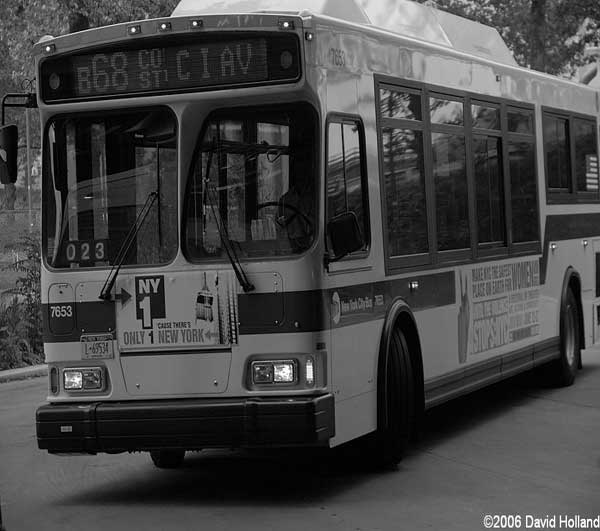
B68 turning around in the Mermaid Bus Loop. Resized photo courtesy of Eye On Transit.
The topic of overtime & sick time abuse has dominated this blog & the mindset of many in the transit community of late. Within the last 25 minutes, the New York Daily News issued a report about how bus drivers who were spat on took an average of two months paid leave. Pete Donohue has more:
MTA bus drivers who were spat on by riders last year got an average two months paid time off after the humiliating experiences, officials revealed Monday.
That’s because transit workers are entitled to get a paid break after an “assault” – which apparently includes spitting.
“We’re going to have to take a look and see what we’re going to do with that,” Joe Smith, senior vice president of buses for NYC Transit, told MTA board members at a committee meeting.
Some 51 drivers took an average 64 paid days off after suffering a saliva assault.
The jaw-dropping statistic comes as the MTA is grappling with a massive budget deficit, laying off workers and planning for fare hikes in January.
“I don’t envy anyone [who is spat upon]… but you have to wonder if you can go home and shower off, take a nap, take off the rest of the day and maybe the next day,” MTA board member Nancy Shevell said at the meeting.
“When it gets strung out for months, you start to wonder,” Shevell said.
Click here for the complete report.
Getting spit on is a disgusting & disrespectful action that should never happen to anyone. With saying that, I can’t condone drivers abusing paid leave over the incident if that is indeed what happened. However I am starting to question whether this fight over overtime and/or sick time abuse is turning into nothing but a witch hunt against transit workers.
It seems the majority of these reports focus on “abuse” & how workers are costing the MTA money. Why not focus on the amount of waste from the MTA’s side from redundant positions to overpaying for goods & services, & the like? Some fairness would be nice!
xoxo Transit Blogger
You might enjoy reading these related entries:
