Fulton Transit Center Update
Just a short time ago, MTA New York City Transit sent out a press release which provided an update on the Fulton Transit Center. The update focuses on construction & upcoming service changes due to it. Here are the complete details:
Over the next two weekends subway riders using the Fulton Street/Broadway-Nassau station complex in lower Manhattan should be prepared for train service diversions along several lines and significant changes in the transfer patterns within the complex, requiring in some cases that customers leave the station and then re-enter in order to change trains, MTA New York City Transit announced.
As the Fulton Street Transit Center reconstruction project continues over the next three years, work will impact customers transferring within the station complex. In this current phase of construction, the AC mezzanine, a ramp and two staircases will be removed and replaced over the course of two weekends: January 9-11 and January 16-18. In addition, other subway work taking place on those weekends will affect travel in Lower Manhattan and Brooklyn. Effective Monday, January 18, a new temporary stair will replace the ramp that connects AC trains to the uptown 45 trains.
Also, the remaining platform stairs will each lead to a specific transfer or street exit. Riders are encouraged to consult way-finding signs and brochures that are available at station booths in midtown and lower Manhattan and downtown Brooklyn. Transit personnel will be on hand both weekends and on Monday, January 18 and Tuesday, January 19, to help direct customers.
At Fulton Street-Broadway-Nassau, from 12:01 a.m. Saturday, January 9 through 5 a.m. Monday, January 11:
• To transfer between A trains and uptown 4 & 5 trains, customers should follow the way-finding signs in the station and use the mezzanine passageway between Broadway and Nassau Street.
• To transfer between the A and Brooklyn-bound 4 & 5 trains, customers must exit the station and re-enter using the station entrance on the northwest corner of Broadway and Fulton Street (next to St. Paul’s Chapel) for Brooklyn-bound 4 & 5 trains.
• Brooklyn-bound 45 customers must exit the station to connect to A train service by re-entering the station at the 222 Broadway entrance (on Fulton Street by the Chase Bank.)
—-
Other Diversions Affecting Travel beginning 12:01 a.m. Saturday, January 9, through 5 a.m. Monday, January 11:
• There is no 2 or 3 subway service into Brooklyn and no 2 or 3 service at Fulton Street/Broadway-Nassau.
• The 4 trains will make all regular 3 train stops in Brooklyn to New Lots Avenue.
• The 5 train will make all regular 2 train stops in Brooklyn to Brooklyn College/Flatbush Avenue.
• The 2 train will operate between 241st Street and South Ferry making all 1 train stops from Chambers Street.
• The 3 train will operate from 148th Street to 14th Street.
• There is no C service; customers should use the A instead, noting that buses replace the A train between Jay Street and Utica Avenue.
—-
At Fulton Street-Broadway-Nassau, from 12:01 a.m. Saturday, January 16 through 5 a.m. Monday, January 18:
• There are no 4 & 5 trains at Fulton Street/Broadway-Nassau
• For uptown 4 trains, customers must use the J shuttle at Fulton Street/Broadway Nassau and transfer for the 4 at Chambers Street/Brooklyn Bridge-City Hall.
• To transfer between downtown 4 and A trains, customers must transfer to the J shuttle at Chambers Street/Brooklyn Bridge-City Hall to reach Fulton Street/Broadway- Nassau.
• For Brooklyn-bound 4 train service, customers should use Brooklyn-bound 2 & 3 trains at Atlantic Avenue.
—-
Other Diversions Affecting Travel beginning 12:01 a.m. Saturday, January 16 through 5 a.m. Monday, January 18:
• There will be no 4 train service between Brooklyn Bridge and Utica Avenue.
• J shuttle trains replace the 4 into Brooklyn from Essex Street to Prospect Park.
• There will be no 5 train service between Grand Central and Brooklyn College-Flatbush Avenue.
• The 3 will make regular stops in Brooklyn to New Lots Avenue and the 2 will make regular stops in Brooklyn to Brooklyn College-Flatbush Avenue.
• There will be no C service; customers should take the A instead. Note that on Sunday, there are no A trains between Euclid Avenue and Lefferts Blvd.
________
MTA NYC Transit apologizes for any inconvenience to our customers. However, when the Fulton Street Transit Complex is complete, there will be more station entrances, additional access to the Lexington Avenue line and connections to the R, W, and E subway lines as well as the PATH hub.
If you would like a visual look into the service diversions listed above, click here to view the .pdf.
xoxo Transit Blogger
You might enjoy reading these related entries:- Fulton Transit Center October Work Schedule
- Fulton Transit Center July Work Schedule
- May Work Schedule For Fulton Transit Center
- Fulton Transit Center November Work Schedule
- Fulton/Broadway-Nassau Look Ahead
LIRR Sets On Time Performance Record Again
For the 3rd consecutive year, the MTA Long Island Rail Road (LIRR) has set a record for on-time performance. The agency just sent me a press release about it a short time ago with more information:
For the third year in a row, MTA Long Island Rail Road set a new On-Time Performance (OTP) record, achieving a best ever 95.21% in 2009.
The 95.21% overall OTP is the best since modern record keeping began in 1979 and included 81 rush hour periods when on time performance reached 100 percent. The LIRR achieved this milestone last year while operating 244,937 trains.
LIRR President Helena E. Williams attributed the improvement in the Railroad’s on time performance to investments in the LIRR’s fleet, better maintenance practices, a robust track work program, better vegetation management along the LIRR Right of Way and, most importantly, the effort of some 6,800 employees across the LIRR who keep customer service and safety as their top priorities all year long.
“We couldn’t achieve these new records each year without the dedication of our workforce,” Williams said. “They make it all happen, in all kinds of weather, day in and day out.”
In customer surveys, On Time Performance repeatedly has been identified as the No. 1 priority of LIRR customers. “Trends indicating improvement are always welcome,” said Maureen Michaels, chair of the Long Island Rail Road Commuters Council.
The previous OTP record of 95.14% was set in 2008. In 2007, OTP reached 94.07%. Last year also saw a record AM peak on-time performance of 95.72%, compared to 95.43% in 2008. The number of off-peak trains operating on-time in 2009 also set a new record of 95.40%, edging out the previous record of 95.32%, set in 2008. Helping to account for a record OTP year were seven months that set individual best ever on-time records. They were achieved in April, May, June, August, September, October and November.
The LIRR also tied a record last year that was set in 1993 for the highest number of 100 percent rush hour periods (81). The previous record was set when the LIRR was operating six percent fewer trains than in 2009.
LIRR On Time Performance in diesel territory, meanwhile, continued to lag behind overall performance with a 93.32% total. Diesel service OTP did improve in 2009 over the previous year, going to 93.32% in 2009 from 92.84% in 2008. The LIRR is continuing to work to address reliability issues that have hampered the performance of its diesel fleet since it was first acquired by the LIRR in 1998.
The LIRR last year celebrated its 175th Anniversary of service to Long Island and to the New York metropolitan region, providing in excess of 80 million customer trips as the busiest commuter railroad in the country.
Last year, the LIRR also provided extra service to the U.S. Open during the weeklong event that drew visitors and media from across the nation to Long Island’s Bethpage Black course. The LIRR provided transportation to nearly a third of all visitors to the U.S. Open, despite often challenging weather conditions. In addition, last year the LIRR continued its modernization efforts, completing a major signal and switch upgrade in the Valley Stream area.
Note: A train is considered on time if it reaches its final destination within 5 minutes and 59 seconds of its scheduled arrival time. The standard measure, used throughout the commuter rail industry, was adopted by the LIRR in 1979. That year the LIRR posted an OTP of 83.42% and began an upward climb of improved performance through the decades.
I have railed on the LIRR a lot & rightfully so at times. However I will not ignore positive accomplishments such as on-time performance. When push comes to shove, if you ask a commuter who does not follow this industry like I do, what is important to them, on-time performance will be near or at the top of their priority list.
While the chances of the agency continuing to improve on the numbers is low (can’t get much higher realistically), continuing in & around the range is a goal within reach. So for the sake of riders (including myself since I try to not always drive), lets hope that they keep it up.
xoxo Transit Blogger
You might enjoy reading these related entries:- LIRR Achieves Record On-Time Performance Yet Again
- Speaking Of Records, The LIRR Sets One As Well
- LIRR Worst Monthly Performance In Decades
- LIRR Commuters Campaign President Calls Out The LIRR
- LIRR Monthly Ticket Sales Decline In May
MTA Board Loses 6 Advocate Board Members
Stop & tell me where you have heard this one before, state politicians in Albany showcase their lack of regard and/or knowledge for the needs of the MTA & the riders it serves. Whether these actions are done purposely or not, the end result is the same. The ineptitude of our elected officials find a way to screw over the riders. The latest sign of this is when the State Legislature failed to renew the authorization of 6 non-voting posts on the MTA Board. These 6 posts belonged to rider & union advocates & included:
Pete Donohue of the New York Daily News has more in this brief report:
Straphangers and commuter train riders may have to scream a little louder to be heard as the MTA makes tough decisions about service cuts.
Rider and union advocates lost their combined six seats on the Metropolitan Transportation Authority board Friday when state legislation authorizing the nonvoting posts expired.
“This is a real shame,” said Andrew Albert, one of the affected board members. “I guess it just wasn’t on the radar.”
Click here for the complete report.
Actions such as this are why I & other transit advocates/bloggers have little to no faith in our elected officials doing what is right by the transit agency & its riders. The agency is arguably under the most pressure in its history to not only keep up the system, provide quality service to its ridership base, but find a way to stay financially afloat, & Albany lets this happen! Should we really be surprised that the positions lost are of those who benefit riders the most? I doubt that this is a coincidence.
We as riders need brand new leadership in Albany & need to vote out the status quo of ineptitude that at this pace will bankrupt the agency & screw us all in the process.
xoxo Transit Blogger
You might enjoy reading these related entries:- Andrew Cuomo Threatens To Sue MTA Board Members
- MTA Says Doomsday Scenario Can Be Avoided
- TWU Dealt A Crushing Defeat
- Elliot Sander Ripped By MTA Board
- MTA Approves Budget Cuts
New LIRR Atlantic Terminal Pavilion Opens
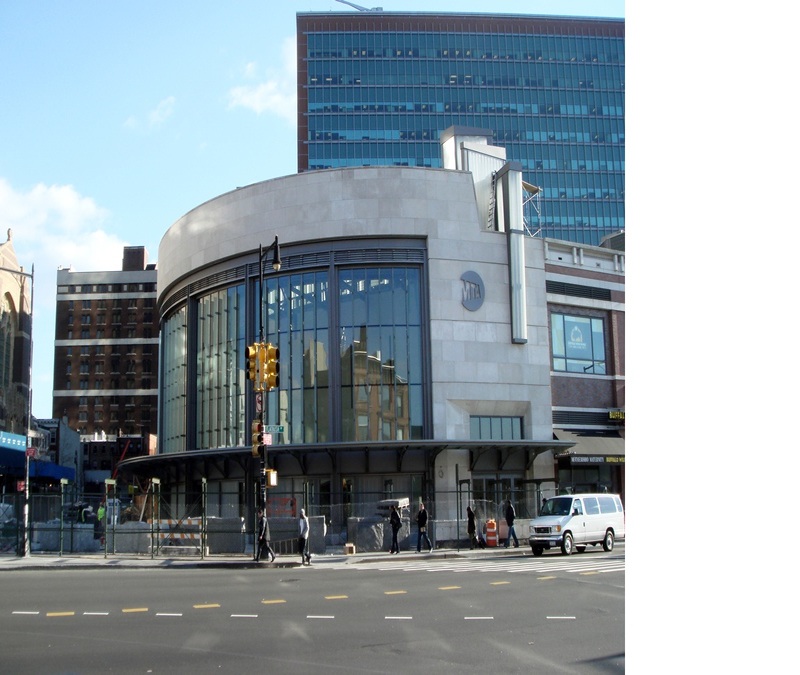
Exterior view of the new MTA Long Island Rail Road Atlantic Terminal Pavilion. Photo courtesy of the MTA Long Island Rail Road.
Anyone who has used the Flatbush Avenue/Atlantic Terminal for the Long Island Rail Road, has noticed it being under construction for the last few years. The majority of the work focused on the creation of a new pavilion. A few days before the end of 2009, “The Brooklyn Paper” had a story which took a sneak peak at the soon to be unveiled work. Here is a little more from Stephen Brown:
After nearly six years of construction, the new entrance to the Long Island Rail Road’s critical Atlantic Terminal at Flatbush Avenue is finally open to straphangers.
Though the ground-floor entrance is blocked off until next week’s grand opening, The Brooklyn Paper got a sneak peak of the concourse, which can be accessed via LIRR platforms.
Commuters looking for the ticket office will find that it has moved to a new location on the concourse below the ground floor entrance, where natural light shines through glass that spans from the road to the ceiling, offering views of the Williamsburgh Savings Bank tower across the street.
Bringing in natural light to the concourse below street-level was one of the top priorities of John di Domenico, the head architect with the Queens-based firm, di Domenico and Partners, which designed the facility.
“As a commuter, light serves as a timepiece, as well as being pleasant — and free,” he said, adding that the previous entranceway had been cramped and poorly lit.
One of the distinctive features of the new space is a rough-hewn granite sculpture featuring craggy geometric shapes that loom over commuters emerging from train platforms.
Click here for the complete story.
Now lets fast forward to today where the MTA Long Island Island Rail Road officially opened the new pavilion with a ceremony this morning. Unfortunately I could not attend the event due to business matters I needed to address. However the agency sent out a press release to me a few minutes ago talking about the pavilion:
Brooklyn’s historic transit hub at Atlantic and Flatbush Avenues – where MTA Long Island Rail Road customers can transfer for connections with 10 subway lines – has a new, $108 million home starting today with the opening of the Atlantic Terminal Pavilion.
The three-story limestone, granite and glass structure features a soaring atrium that allows natural light to reach the below ground LIRR concourse and subway station. Two sweeping staircases provide direct access from the street to the concourse below. The Terminal building is linked internally to an office building and retail complex.
While the interior of the new entry pavilion provides customers with open spaces and an impressive overlook of the terminal, the arced vessel shaped exterior restores a “civic presence” to the Flatbush Avenue site, according to Brooklyn native John di Domenico, the architect of di Domenico & Partners, LLP who led the design of the Entry Pavilion.
“This new terminal means improved interconnectivity between the Long Island Rail Road and New York City Transit’s subways and buses – with better information and a more spacious, comfortable and accessible facility,” said Jay H. Walder, Chairman and CEO of the MTA. “The glory of the original 1907 Flatbush Avenue Terminal has been restored in modern form.”
“This grand new entry pavilion will benefit our customers for generations to come as well as become a landmark for Brooklyn,” said LIRR President Helena Williams. “The sunlit atrium and three-story exterior evoke the transit terminals of past eras that properly greeted travelers at such a busy hub.”
Brooklyn Borough President Marty Markowitz said: “The spectacular Atlantic Terminal Pavilion will not only serve as a 21st century transportation hub for tens of thousands of daily LIRR, subway and bus riders, but this magnificent facility will let visitors to our borough know—in dramatic fashion—that they have arrived in Brooklyn, USA and our vibrant Downtown. And what a pleasure it will be for our neighbors in Nassau County (aka Brooklyn Near East) and Suffolk (aka Brooklyn Far East) to enjoy visiting us more often. Bravo to the MTA Long Island Rail Road and the Federal Transit Administration for making this project a reality and helping to keep Brooklyn moving—and growing.”
The renewed facility serves approximately 25,500 LIRR customers each day as well as approximately 31,650 NYC Transit subway customers. LIRR customers can transfer to the 2,3,4,5, B, D, M, N, Q & R lines as well as five bus routes.
Work on the project, begun in 2002, was done in two phases in order to coordinate improvements with MTA New York City Transit work on their subway facilities and a private developer, Forest City Ratner.
The new Pavilion includes a new ticket office, public rest rooms, grand stairs, customer waiting area, police and employee facilities, granite floor tiles, Arts for Transit installation, information signage, lighting and a new HVAC system. The hours of operation for the Entry Pavilion are 5 AM to 10 PM and the Atlantic Terminal Ticket Office is open from 6 AM to 10 PM. Train service to the terminal, ticket machines and elevator are available 24/7.
Earlier work completed during the first and early second phases of the work included a temporary ticket office and entrance, new platform lighting, platform seating, signage and public address system, granite floor tiles for platforms, finished ceiling and stainless steel platform column cladding.
The pavilion is an architecturally distinct work. Architect John di Domenico, of di Domenico + Partners, LLP, Parsons Brinckerhoff Engineers, and artists Allan and Ellen Wexler, commissioned by MTA Arts for Transit, collaborated to incorporate the artwork called “Overlook” into the Pavilion’s design. From street entry level, customers can observe the busy Terminal platform below. The Pavilion also has “green” environmental pluses. The large high performance glazed curtain wall and skylight allow abundant natural light to reach the LIRR concourse and the 2, 3, 4 and 5 subway station. Also, shading “fins” on the exterior glass wall and skylights prevent excess heat gain during the warmer months.
John di Domenico, the architect, was raised in Brooklyn and attended Brooklyn Technical High School before going on to the City College of New York and Harvard University. He also was a Fulbright Scholar in Rome, Italy. His firm is based in Long Island City.
The budget for the Atlantic Terminal improvements was $108.1 million with funding provided by the Federal Transit Administration and the MTA Long Island Rail Road Capital Program.
LIRR service between Jamaica and Brooklyn dates back to the earliest days of the railroad in the 1830’s. The earlier LIRR Brooklyn terminal building, located at approximately the location of the present structure, opened in 1907 as part of the Atlantic Avenue Improvement Project. That project also included construction of two tunnels and two elevated sections with electrified tracks for the LIRR between Atlantic Avenue, Brooklyn and Jamaica.
The new Atlantic Terminal building marks an early milestone in the overall effort to transform this area of Brooklyn. A recent court decision cleared the way for a new sports center that is to be the new home of the Nets basketball team. Additional residential and commercial buildings also are planned nearby.
The sample photos shown in the press release look quite impressive. I will eventually get to the terminal so I can photograph it for Eye On Transit. If anyone reads this & happens to check out the terminal, please contact me with your opinions on the project from different perspectives such as looks & functionality. In the meantime, checkout these 2 extra shots of the new terminal courtesy of the MTA Long Island Rail Road.
You might enjoy reading these related entries:- LIRR Announces Tuesday A.M. Service Changes
- LIRR Service Affected For A.M. Commute
- MTA Extends LIRR Atlantic Ticket Program
- LIRR Announces P.M. Rush Service Changes
- East New York Track Work To Affect Weekend LIRR Service
New Bus Driver Safety Partition Debuts

Newly installed bus driver safety partition in action on the B46. Photo courtesy of Ward for the New York Daily News.
Almost 13 months after the tragic murder of MTA New York City Transit bus driver Edwin Thomas, a new safety partition, that might have prevented his murder, debuts. Lets first take a look at the report talking about its debut by Pete Donohue of the New York Daily News:
The bus guard has arrived.
An NYC Transit bus outfitted with an L-shaped partition shielding the driver from potential harm is operating on the B46 line in Brooklyn – the same route where a driver was fatally stabbed by a farebeater a year ago.
The agency has ordered 100 of the see-through barriers – created with input from drivers and Transport Workers Union Local 100 – for an expanded pilot test.
“It gives us peace of mind, I guess,” NYC Transit driver Wayne Roberts, 40, said while driving behind the bus guard Thursday afternoon.
Roberts, though, lacked total confidence in the partition because it doesn’t completely seal off the driver.
There’s an open space extending from the farebox to the windshield, which allows the driver to access the fare-collecting unit. An irate passenger hell-bent on harming a driver may not be deterred.
Still, drivers agreed, it’s a significant upgrade. There were 313 physical assaults on drivers through mid-November this year, according to union officials, and drivers say it’s not uncommon for riders to spit on them.
Click here for the complete report.
Now lets take a look at a few details about the partition courtesy of MTA NYC Transit’s V.P. of Corporate Communications Paul J. Fleuranges by starting with an alternate photo:

The partition is made of plexiglass with non glare coating. Doesn’t fully enclose the driver; open at very top and forward of driver compartment.
The glass is one half inch thick.We are ordering a total of 100 for RTS buses and working on other bus models.
It’s difficult to come up with a ‘one-size-fits-all’ approach to this simply because our Bus Operators aren’t one size. Each has to position the wheel, seat, mirrors to their preference, same is true for something like a partition. They all have to be comfortable with the environment the partition creates as they drive. Our overriding goal here is to provide both a safe and comfortable environment for.
I am glad to see these partitions are starting to see the light of day. It is unfortunate that it took a death of a dedicated employee to implement such a common sense safety measure. However this is how it always seems to work in life which is a shame. Hopefully such devices as this will deter people from any attempts at hurting a bus driver.
xoxo Transit Blogger
You might enjoy reading these related entries:
